Low Latency, High Performance: The Future of Trading Systems
Table of contents
In today’s hypercompetitive financial markets, the difference between profit and loss can be measured in microseconds. Low-latency, high-performance trading systems are no longer optional they’re essential infrastructure for broker-dealers. With 89% of global trading volume driven by AI algorithms and the HFT market growing at 7.7% annually, speed directly translates to competitive advantage.
The Performance Imperative: Understanding Low Latency in Modern Trading
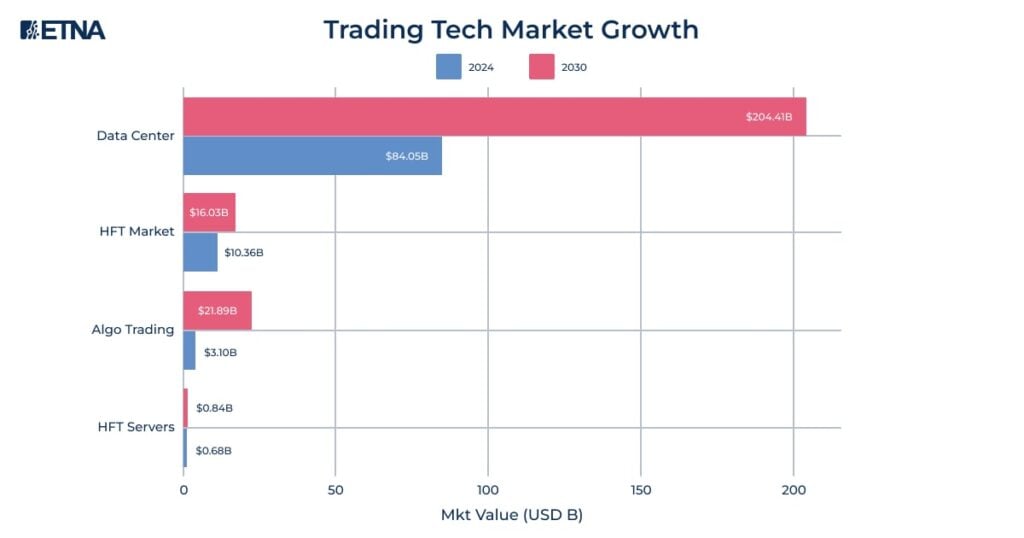
Low-latency trading minimizes time from market data receipt to order execution reducing delays from hundreds of milliseconds to microseconds or nanoseconds. The global high-frequency trading market reached $10.36 billion in 2024, projected to hit $16.03 billion by 2030, demonstrating that speed is now fundamental.
Key Performance Reality: Every millisecond of latency translates to measurable lost opportunity. In 2007, a major investment bank estimated $100 million per year lost per millisecond.
Critical Latency Metrics
Tick-to-Trade Latency: Time from receiving market data to submitting an order
Market-to-Client Latency: End-to-end delay from exchange execution back to client system
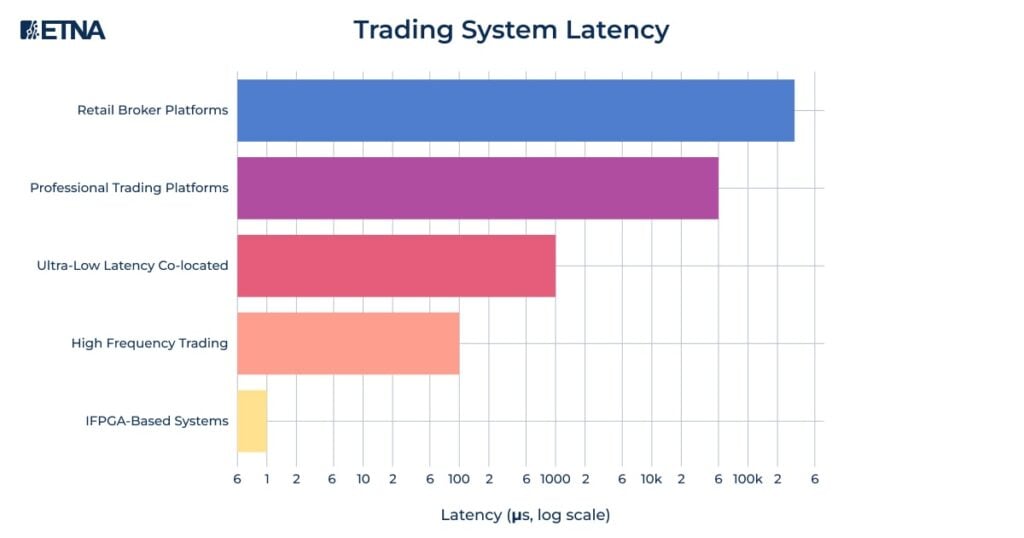
Professional Platforms: Sub-100 millisecond execution for algorithmic strategies
Ultra-Low Latency Systems: Sub-millisecond performance in colocation facilities
High-Frequency Trading: Execution under 100 microseconds
FPGA-Based Systems: Sub-microsecond processing
Physical Constraints: Fiber optic transmission at 4.9 microseconds per kilometer means the New York-to-London round-trip adds ~65 milliseconds purely from distance. This explains why colocation placing servers in exchange data centers is essential for competitive trading.
Market growth projections for trading technology segments from 2024 to 2030, showing the rapid expansion of algorithmic trading, HFT infrastructure, and colocation services
Architectural Blueprint: Building High-Performance Trading Infrastructure
Hardware Layer: The Foundation of Speed
The tick-to-trade path flows from market data → optimized NICs → OS bypass → trading logic → order gateways. Each component must be engineered for minimum delay.
FPGAs vs. CPUs:
FPGAs execute operations in parallel, achieving nanosecond-level response times
CPUs process instructions sequentially, requiring milliseconds
FPGAs outperform high-end CPUs by up to 1,000x for latency-critical tasks
Implement core isolation and pinning to dedicated threads
Minimize context switching overhead
Optimize cache coherence to keep critical data in L1/L2
Latency comparison across trading system types, demonstrating the dramatic performance differences between retail platforms and ultra-low latency FPGA-based systems used in high-frequency trading
Network Infrastructure: Minimizing Transport Delays
Data Center Colocation Advantage:
Places trading infrastructure adjacent to exchange matching engines
Market Context: The colocation market reached $84.05 billion in 2024, projected for $204.41 billion by 2030 (14.4% CAGR) growth driven by financial services demand.
Software Optimization: Extracting Maximum Performance
Operating System Tuning
Best Practices for Ultra-Low Latency:
Disable hyperthreading to eliminate resource contention
Use real-time kernel variants for deterministic scheduling
Isolate critical processes on dedicated CPU cores
Configure interrupt affinity to route network interrupts appropriately
Programming for Determinism
Language Selection:
C/C++: Preferred for minimal runtime overhead and fine-grained memory control
Java: Viable for moderately latency-sensitive applications with proper tuning (garbage collection optimization, JVM warm-up, escape analysis)
Lock-Free Data Structures:
Ring buffers enable threads to communicate without mutex locks or semaphores
The producer writes while the consumer reads simultaneously without blocking
Appears throughout trading systems for market data, orders, and execution reports
Memory Access Optimization:
Sequential access patterns exploit CPU cache prefetching
Allocate frequently-accessed objects from memory pools, not the heap
Memory-mapped files provide zero-copy access to persistent data structures
AI, Machine Learning, and the Evolution of Trading Intelligence
Market Transformation:
AI algorithms drive 89% of global trading volume (2025)
AI trading market projected to reach $35 billion by 2030
Processes 2.5 quintillion bytes of data daily across financial markets
AI Integration Within Low-Latency Architecture:
Pre-compute features offline where possible
Use optimized inference libraries (TensorFlow Lite, ONNX Runtime)
Offload compute-intensive operations to GPUs or AI accelerators
JPMorgan’s LOXM system demonstrates success: uses supervised learning to optimize trade execution and reduce slippage
Advanced AI Techniques:
Reinforcement Learning: Agents learn optimal actions through trial and error, adapting continuously to market microstructure
Natural Language Processing: Analyzes news, social media, earnings transcripts, and regulatory filings for sentiment-driven trading signals
Real-Time Pattern Recognition: Identifies opportunities impossible through traditional rule-based approaches
The Broker-Dealer Advantage: Why Performance Infrastructure Matters
Competitive Differentiation
Client Attraction Through Execution Quality:
Sophisticated algorithmic traders evaluate brokers on fill rates, slippage, and speed
Low-latency systems have transitioned from competitive advantages to essential infrastructure. Markets dominated by AI-driven algorithms demand technology capable of matching that pace. The investments required whether custom infrastructure or partnerships generate returns through:
Improved client acquisition and retention via superior execution quality
Operational efficiencies that reduce costs
Regulatory compliance that minimizes audit risk
Better execution quality that preserves client assets
With the HFT market growing at 7.7% and algorithmic trading reaching $21.99 billion by 2033, the trend toward automated, speed-optimized trading will intensify. Organizations that modernize infrastructure now position themselves advantageously for the next decade.
Take the Next Step: Request ETNA’s Performance Optimization Guide
Ready to transform your trading infrastructure? Request ETNA’s comprehensive Performance Optimization Guide to learn how their platform handles millions of daily transactions with institutional-grade speed and reliability. Discover architectural approaches, implementation strategies, and real-world performance benchmarks. Contact ETNA Software today to schedule a consultation and explore how their platform elevates your competitive position in today’s speed-driven markets.
Frequently Asked Questions
Colocation places trading servers in exchange data centers, eliminating transmission delays inherent in remote hosting. Direct cross-connects (dedicated fiber) bypass public internet routing. Physical proximity combined with optimized pathways reduces latency from hundreds of milliseconds to single-digit milliseconds or microseconds. The difference often determines strategy profitability.
FPGAs execute operations in parallel through configurable hardware logic, achieving nanosecond response times versus CPU sequential processing (microseconds/milliseconds). Benefits include: Parallelism: Multiple operations simultaneously Deterministic timing: Consistent latency regardless of system load Speed advantage: Up to 1,000x faster than CPU software for specific tasks Ideal for protocol decoding, risk checks, and market data parsing.
Essential monitoring tools include: Network: SmokePing, Iperf for round-trip timing Host Performance: perf, Intel VTune for CPU behavior analysis Jitter Measurement: Quantifying timing variability Synchronization: Precision Time Protocol (PTP) for accurate timestamps Application Instrumentation: Capturing tick-to-trade latency per pipeline stage Combine with automated alerting that notifies operations teams immediately when latency exceeds thresholds.
Ask us anything about platforms, integrations, or business growth.
We use cookies and similar technologies that are necessary to run our website. By clicking “Accept,” you agree to our Cookie policy and Privacy policy.