Running Effective Account Audits with ETNA: How Asset Audit Tools Keep RIAs Audit‑Ready
Table of contents
The RIA business is scaling faster than most firms’ compliance operations:
SEC‑registered RIAs hit 26,669 firms serving 68.4M clients in 2024 (up 6.8% YoY).
AUM rose 16.6%, revenue 17.6%, dramatically increasing transaction and data volume per firm.
SEC and state regulators are tightening enforcement, with $390M+ in recordkeeping fines against 26 firms alone.
In this environment, effective account audits are no longer periodic chores; they’re a permanent capability. The right asset audit software, asset tracking system, and asset management tools can transform regulatory, internal, and portfolio audits from fire drills into routine workflows.
The Three Pillars of RIA Audits (and Why They Matter)
RIAs have to juggle regulatory, internal, and portfolio audits each with different stakeholders and goals.
Audit Type
Conducted By
Primary Focus
Frequency
Objective
Outcome
Regulatory Audits
External regulators (SEC, FINRA, state)
Financial statements, securities law compliance
SEC: 3–5 years; State varies
Verify regulatory compliance
Public report, enforcement actions
Internal Audits
Internal team or consultants
Internal controls, operations, risk management
Continuous/quarterly/semi-annual
Strengthen controls, identify improvements
Internal reports for management
Portfolio Audits
Internal team + custodian verification
Investment holdings, allocation, performance
Quarterly or as needed
Verify investment accuracy and valuations
Reconciliation reports, documentation
Three essential types of audits that RIAs must manage: regulatory, internal, and portfolio audits. Each serves distinct compliance and operational purposes
Regulatory Audits (SEC, FINRA, State)
Who runs them:
SEC, state securities regulators, and occasionally FINRA for dually registered entities.
Frequency:
SEC: About every 3–5 years; some states (e.g., Ohio) every 2 years.
Multi‑location, multi‑entity support for growing firms.
This is the backbone for a real information technology asset management software stack tailored to RIAs.
ETNA’s Automated Compliance Features: Built for Audits
ETNA’s asset management app for broker‑dealers and RIAs embeds automation directly into trading and back‑office workflows, eliminating large classes of manual work.
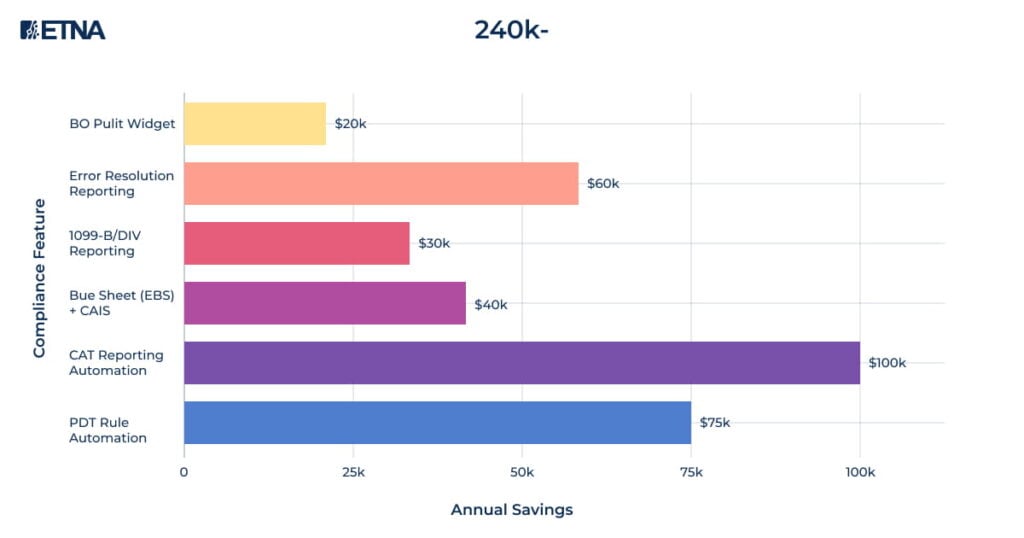
ETNA’s automated compliance features deliver $240K-$580K in annual cost savings per broker-dealer while reducing FTE requirements by 1-2 positions
Key Automated Compliance Components
Approximate annual savings ranges below are midpoints of typical ranges:
PDT Rule Automation
Continuous pattern day trader monitoring and enforcement.
Savings: ~$75K/year (0.5–1 FTE).
CAT Reporting Automation
Real‑time capture and submission of CAT data to FINRA.
Savings: ~$100K/year vs third‑party vendors and manual reconciliation.
Blue Sheet (EBS) + CAIS Automation
Automated generation, validation, and delivery for regulatory requests.
Savings: ~$40K/year in outside vendor/consulting spend.
1099‑B/DIV Reporting
Built‑in tax calculations and IRS‑ready reporting.
Savings: ~$30K/year in tax reporting labor and vendor fees.
Error Resolution Reporting
Real‑time detection of trade, settlement, and pricing exceptions.
Replaces third‑party asset audit software often costing $10K–$30K/year.
Aggregate Impact
Total annual savings: approx. $240K–$580K per broker‑dealer.
Staffing impact: reduction of 1–2 FTEs in manual compliance operations.
Audit impact:
Ready‑made evidence for regulatory, internal, and portfolio audits.
Centralized logs instead of patched‑together spreadsheets and email trails.
This is effectively a specialized network asset management software + trading + compliance stack for capital markets.
A Practical Playbook for Audit‑Ready Operations
Move from Periodic to Continuous Monitoring
Implement always‑on compliance and portfolio drift monitoring.
Use rules and thresholds for:
Allocation drift and risk limits.
Concentration, liquidity, and volatility exposure.
Marketing and AI‑usage policy checks.
Treat continuous monitoring as your default asset scheduling software for reviews and rebalancing.
Standardize Reconciliation and Documentation
Before any audit:
Reconcile all accounts and prepare trial balances.
Tie sub‑ledgers back to the general ledger.
Standardize:
Folder structures and naming for audit evidence.
How you store risk assessments, supervisory tests, and corrective actions.
Use asset search software capabilities (global search, filters, tags) in your platforms to find supporting evidence in seconds, not days.
Assign Clear Ownership and Realistic Timelines
Define owners for:
GL accounts and reconciliations.
Portfolio audits by strategy or model.
Compliance program reviews under 206(4)‑7.
Create an annual calendar that covers:
Quarterly internal reviews and fee audits.
Annual full compliance review (documented).
Mock SEC/State exams every 1–2 years.
Automate Evidence Collection
Use compliance platforms that:
Pull data automatically from trading, CRM, HR, and online asset tracking tools.
Map controls to multiple frameworks and regulations (SEC, state, AML/BSA).
Generate pre‑built audit reports for different use cases (regulatory, internal, client).
Aim to reduce manual evidence gathering by 70–90% using automation.
Run Pre‑Audit Internal Reviews
Before regulators or external auditors show up:
Run an internal “mini‑exam” using your own playbook.
Sample: trades, marketing, fee calculations, portfolio allocations, and AI usage logs.
Document each finding using “5 Cs”: Criteria, Condition, Cause, Consequence, Corrective action.
Communicate and Remediate
During real audits:
Maintain a single point of contact.
Hold regular status meetings to resolve issues early.
After audits:
Document what went well, what didn’t, and update policies and workflows accordingly.
How AI and Emerging Tech Are Rewriting the Audit Playbook
AI for Full‑Population Testing (Not Just Samples)
Machine learning systems now review 100% of transactions, not small samples.
They flag anomalies such as:
Out‑of‑pattern trading behavior.
Mispriced positions or stale valuations.
Unusual fee movements or discounts.
Automated Portfolio Rebalancing and Execution
Modern tools provide:
Continuous drift monitoring and threshold‑based rebalancing triggers.
Rules‑driven allocation logic per client or model.
Smarter order routing to reduce slippage and execution costs.
This is where “AI stock trading” and mobile asset management software converge into real, auditable workflows instead of marketing buzzwords.
Blockchain and Immutable Records
Blockchain‑style ledgers provide:
Tamper‑proof transaction histories and ownership records.
Strong evidence for valuation and existence tests.
Combined with traditional equipment asset management software or technology asset management software, you get both physical and financial asset assurance.
Continuous Auditing
Instead of annual “big bang” audits:
Controls are tested throughout the year.
Issues are identified and corrected in‑flight.
Benefits:
Shorter year‑end engagements.
Fewer “surprise” findings.
A culture that sees audits as a feedback loop, not an event.
Building Your Audit‑Ready Tech Stack
Assess Your Current State
Where do you still rely on:
Spreadsheets for asset inventory tracking software functions?
Email for approvals and exception handling?
Quantify:
Time spent on exam prep and reconciliations.
Error rates discovered in internal fee or portfolio audits.
Define Integration Requirements
Look for it asset management software and asset management accounting software that integrate with:
Trading and portfolio accounting platforms.
Custodian and bank data feeds (multi‑custodian is critical).
HR and access management (for user provisioning and vendor oversight).
Archiving and communications surveillance tools.
Prioritize Audit‑Ready Reporting
Must‑have capabilities:
Full audit trails and user activity logs.
One‑click export of reconciliations, fee reports, and control tests.
Auditor‑friendly views with read‑only access when appropriate.
This is where “best asset software” is differentiated from point solutions full audit support is not optional.
Model Total Cost of Ownership (TCO)
Include in your TCO model:
Software licensing (per user / per account / per AUM band).
Implementation + data migration.
Training and change management.
Integration and ongoing maintenance.
Compare that to:
Manual staff hours saved.
Consultants no longer needed.
Fewer and smaller enforcement actions / remediation projects.
Consider Managed & Fractional Models
For firms at $100M–$500M AUM, a fractional CCO plus strong it asset management companies / RegTech stack can:
Cut compliance leadership costs by 40–85% vs full‑time.
Deliver better technology and process maturity than DIY models.
Conclusion: Turn Audits from Headache into Advantage
Pulling it together:
Audit complexity is rising alongside RIA growth and AI‑driven products.
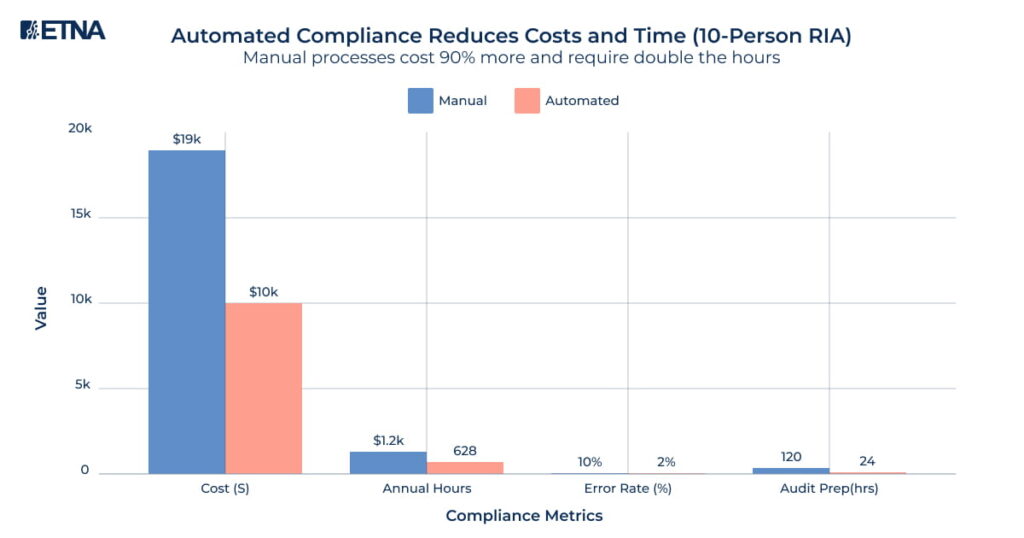
Manual processes are too slow, too error‑prone, and too expensive.
The combination of:
Modern asset management application and asset tracking system,
AI‑driven monitoring and anomaly detection, and
ETNA’s automated PDT, CAT, Blue Sheet, tax, and error‑resolution workflows
gives RIAs and broker‑dealers a permanent audit‑ready posture rather than a once‑a‑year panic.
Firms that embrace automation now enjoy:
Lower operating and compliance costs.
Faster, smoother regulatory and internal audits.
Better risk visibility across client accounts and portfolios.
More time for actual advisory work and less time assembling binders.
In short: effective account audits are no longer just about passing exams. With the right asset management tools and ETNA’s automated compliance features, they become a strategic capability that protects your firm, delights regulators, and builds durable trust with clients.
Ask us anything about platforms, integrations, or business growth.
We use cookies and similar technologies that are necessary to run our website. By clicking “Accept,” you agree to our Cookie policy and Privacy policy.