22.07.2025


In just a decade, “back-office software” has morphed into the main growth engine for U.S. broker-dealers and RIAs. The firms winning new assets in 2025 are not always the biggest or oldest; they are the ones whose trading technology lets them launch products quickly, meet ever-tighter regulations, and delight clients on any device. This article tells the story of how modern stacks emerged, why they matter to decision-makers, and where an ecosystem such as ETNA fits in.
Until recently, most executives treated platforms as an IT cost centre. Two broad shocks changed the mood. First came the speed shock: retail investors now expect a one-tap trade to fill as fast as a TikTok scroll, while regulators demand CAT data in near–real time instead of next day. Then came the scope shock: tokenised Treasuries, 24-hour crypto markets, and a flood of alternative data forced brokers to rethink every layer from market gateways to compliance bots.
The result is strategic urgency. A cloud-native, API-first stack converts technology from overhead to advantage, lifting onboarding throughput, widening product menus, and shrinking error rates. Firms that cling to nightly batch files can still function, but they move through molasses while competitors sprint.
Before we dive into trends, it helps to sketch the architecture that makes today’s breakthroughs possible.
For forward-thinking firms, mastering these pillars turns basic trading tech into a durable competitive advantage.
| Shift | Business Impact | Platform Requirement |
| Algorithms own the volume | About 70 % of U.S. equity trades are generated by code, not people. | High-throughput API gateways (FIX/REST) move from optional to essential. |
| Data goes off-road | Card-swipes, geo-pings, and other alt-data now drive trading signals. | Risk and analytics layers must ingest non-standard JSON feeds, not just price quotes. |
| Markets never close | Crypto and tokenised Treasuries trade 24/7; positions live in digital wallets. | The OMS must reconcile on-chain balances alongside DTC shares without nightly batches. |
| Dashboards turn to Lego | Advisors expect to assemble client views by dragging widgets, not filing tickets. | UI components need a modular framework so changes deployed without full-app releases. |
| Liquidity jumps worlds | Orders can move from the NYSE to a DeFi pool in seconds. | Clearing connectors require dual rails: one for DTCC, one for blockchain settlement. |
| AI patrols compliance | Regulators demand real-time detection, not next-day reports. | Stream-based AML and CAT tagging must trigger at order entry. |
| Voice becomes a shortcut | Some RIAs rebalance via voice: “Shift Model A to 60 % equities.” | Natural-language APIs reduce clicks and elevate client experience. |
Notice how the shifts reinforce one another: 24/7 assets force real-time risk; real-time risk stays cost-effective only on elastic cloud; cloud savings appear fastest when the architecture is already API-first and widget-based. That domino effect explains why forward-looking brokers are upgrading now.
ETNA positions itself as one of the few end-to-end trade tech solutions designed for mid-sized U.S. brokers that need speed, branding control, and seamless growth.
For mid-market firms, the net effect is dramatic: fewer vendor invoices, shorter product cycles, and an easier story for regulators because all data lives in one schema.
| Option | Who Usually Chooses It | What You Gain | What You Give Up |
| A. All-in-One, White-Label Platform(ETNA, DriveWealth, Apex) | Mid-sized broker-dealers, fintech start-ups, and hybrid RIAs | – Branded web + mobile apps in weeks- Multi-asset OMS, clearing links, reporting, and compliance in one contract- REST/WebSocket APIs for custom features | Latency in the low-milliseconds range—good for retail flow but not “HFT-level” speed |
| B. Ultra-Low-Latency Ladder Engine(Trading Technologies, CQG, Sterling Trader) | Prop desks, futures/derivatives specialists, HFT funds | – Co-located servers & ladder UI- Microsecond execution in CME / ICE markets | Little or no retail front end, no built-in back office; you must integrate it into an existing broker stack |
How to decide
How does modern broker-dealer software stay future-proof?
By combining a cloud core with open APIs, firms can swap or upgrade individual modules without taking the front end offline.
Does cloud hosting compromise data sovereignty?
Major providers let you pin workloads to U.S. regions; ETNA also offers private VPC deployment when regulators insist.
Can an API trading platform really reduce compliance effort?
Yes, because CAT tags, CBRS reports and AML flags are generated at the moment of execution, eliminating manual reconciliations.
What if we add self-clearing later?
A clearing-agnostic design keeps your core intact – swap out the connector, not the platform.
Faster decision-making tools, cross-border KYC frameworks, and modular frontend architecture will shape the next wave, but the principle remains: keep the core modular, cloud-elastic, and API-exposed. Firms that embed those traits will treat new regulations and asset classes as software upgrades, not existential projects.
Trading technology is no longer “the system ops uses at 6 p.m.” It is customer experience, compliance posture, and product strategy rolled into code. Whether you build or buy, the yardstick is clear: Does your stack help you outperform, adapt, and scale? If the answer is shaky, it may be time to explore an ecosystem like ETNA – spin up a sandbox, test every endpoint, and watch how quickly new ideas move from whiteboard to production.

Demo Financial Advisor Software
Manage portfolios with advanced rebalancing and real-time insights.
Access customizable client reports and streamlined compliance tools.
Designed for advisors seeking efficient client and portfolio management.

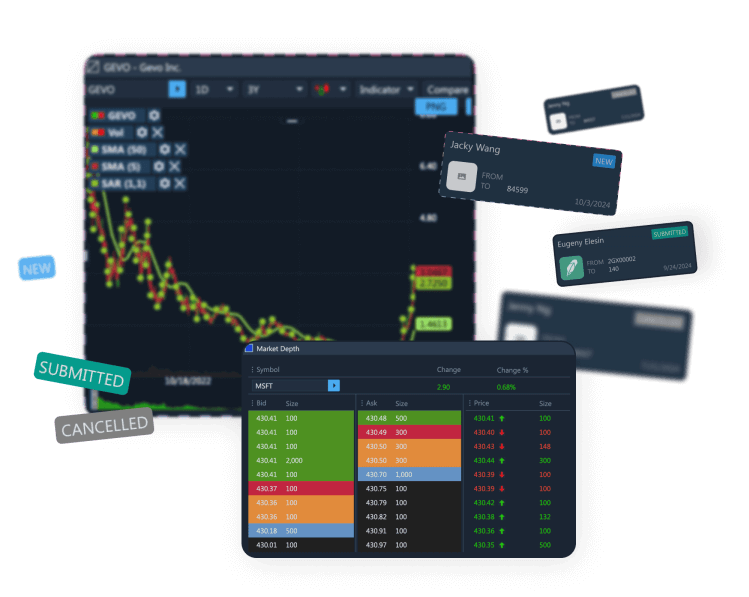
Demo Advanced Trading Platform
Test multi-asset strategies with real-time and historical data.
Analyze market depth, execute complex options, and algorithmic orders.
Ideal for refining strategies and risk management before live trading.

Demo Paper Trading Platform
Practice trading with virtual funds in real market conditions.
Simulate cash, margin, and day-trader accounts to gain experience.
Perfect for honing skills in a risk-free, customizable environment.