20.10.2026

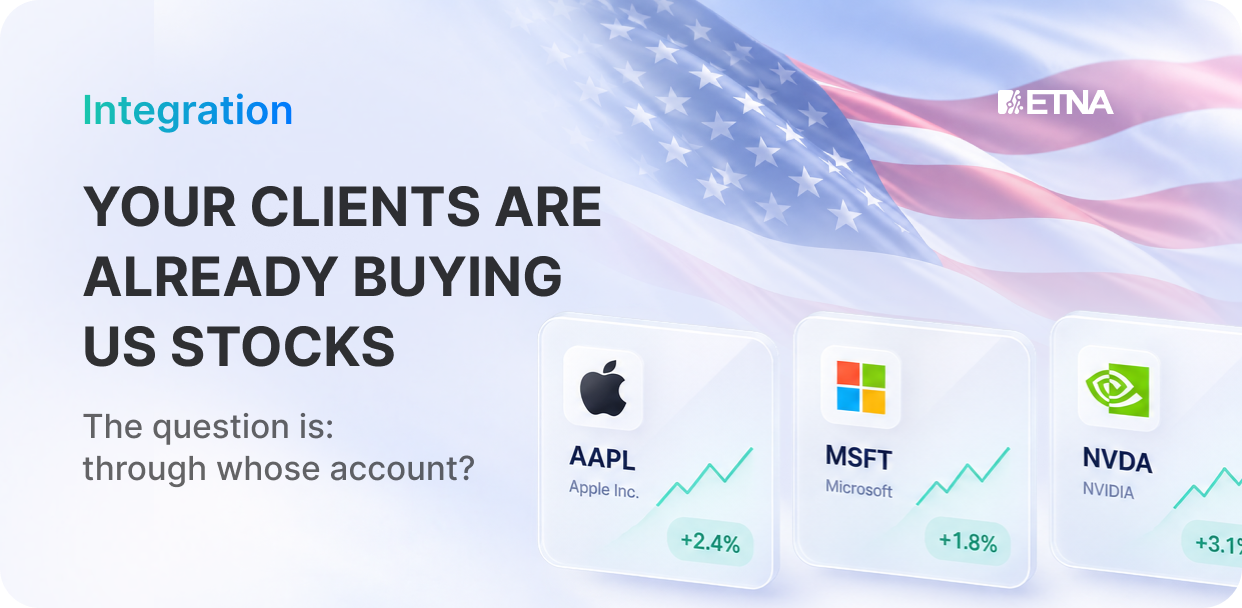
Over the past few months, we’ve talked with banks, brokers, and investment firms from different regions about getting into the US market. The same questions came up on almost every call, so we decided to answer them in one place and walk through the whole process. We’ll tell the story through one bank, which we’ll simply call “the Bank.” It’s a composite, but every question it asks is real: we heard each one on our calls. And if you run a brokerage or an investment firm, the path is the same, and so are the questions.
Let’s start with one of the Bank’s clients. It’s evening, and they open an app they use every day. Their salary lands here, along with their savings, their card, and every transfer they make. Tonight, though, they want something different: a few shares of Apple. The app doesn’t have them. It might offer CFDs, contracts for difference, but this client wants to own the actual shares.
So that same evening, they fill out an application with an international broker, and a few days later they wire over their first deposit. The Bank only sees it on a statement: an outgoing transfer to a recipient abroad. The next one will probably be larger.
From the outside, nothing has changed. The client hasn’t gone anywhere. The paycheck still arrives, and the card is still in their wallet. But the money they chose to invest now sits somewhere else, and every decision about it happens in someone else’s app. For the Bank, it’s a quiet outflow, the kind that never shows up in churn reports.
The Bank has noticed. It already has its own app, its own books, and its own back office. What it’s missing is the market itself. The goal is simple: clients should be able to buy the same stocks without leaving the Bank’s app. That’s where our conversation started, and two minutes in, the Bank asked: “So the client opens an account with us, and we just give them a trading terminal?”
The answer depends on how a bank connects to the US market, and there are only two models.
Under a fully disclosed model, your client opens an individual US brokerage account. They fill out a long application under US rules, their information goes to a US clearing firm, and the account is opened in their name. The clearing firm holds the securities, handles settlement, and sends the client statements, trade confirmations, and tax forms directly. You bring in the client and provide the app, but the account is theirs, and they’re free to transfer it to another broker.
Under an omnibus model, you open a single US account for all of your clients. The clearing firm vets your institution as a company and then works with that one account: it holds the securities, settles the trades, and reports to you. Your clients open accounts with you, you keep the books for each of them, and your local regulator oversees how you do it. Each client still owns the actual shares, just as they would under fully disclosed. What changes is where that ownership is recorded: on your books rather than at the US clearing firm, which sees only your omnibus account. For the client, US stocks simply become one more tab in the app they already use.
For the basics of how omnibus accounts work, see our earlier article: https://www.etnasoft.com/omnibus-account-essentials-strategic-uses-provider-selection/
It comes down to four questions:
| Fully disclosed | Omnibus | |
| Where is the client’s account? | At a US clearing firm, in the client’s name | On your books. In the US, there’s only your omnibus account |
| Who onboards and verifies the client? | The US clearing firm, using its own application | You, under your own rules and your regulator’s requirements |
| Who sends statements and tax documents? | The clearing firm | You. The clearing firm reports only on the omnibus account |
| Whose client is it? | The client has their own US account and can take it to another broker | Yours |
In the US, introducing brokers typically clear on a fully disclosed basis, since their clients already live under US rules. Outside the US, banks and brokers more often start with omnibus, and the last row of the table explains why: the client stays with you. The application, the agreement, the money, and the app all stay in-house, while the US side deals with a financial institution supervised by its own regulator. The Bank didn’t hesitate either: to start, most likely omnibus.
The two models aren’t mutually exclusive. Some institutions run both: some clients trade through the omnibus account, others get individual accounts. Technically, that’s a matter of platform configuration, not a separate project.
On paper, it looks like a legal choice: whose agreement, whose regulator, whose reporting. In practice, it decides who does the work every single day. Under fully disclosed, the clearing firm carries most of it. Under omnibus, it moves to you and your platform. The easiest way to see what that work involves is to follow a single order.
The Bank looked at our diagram, arrows and all, and asked for something else: “Walk us through it with one client. What actually happens?” Fair enough. The Bank has gone with omnibus, and our client is now buying Apple not from an international broker but in the app they already know.
Funding. The client moves money into their brokerage account at the Bank as easily as any other transfer, and the balance shows up in the app right away. For the Bank, though, that’s where the money’s journey begins. US trades settle in dollars through the Bank’s omnibus account at the clearing firm. So the Bank has to decide up front which currency client accounts will use and how much cash to keep in the US to cover every order.
The order. The client picks Apple, enters ten shares, and taps “Buy.” The platform checks buying power twice: first in the client’s own account, then in the Bank’s omnibus account. Only if both have enough does the order go to market, and it goes in the Bank’s name. To the market, it’s a trade in the omnibus account.
The fill. Once the order is filled, the result flows back into both layers of the books. Ten shares appear in the client’s app, and the Apple position the Bank holds for its clients in the omnibus account grows by exactly the same amount.
The next morning. Early in the morning, New York time, the clearing firm sends files for the omnibus account: balances, positions, margin requirements. The platform reconciles them against its own books. All client positions combined must match the omnibus account down to the last share, and any discrepancy has to be found and explained before the market opens.
Dividends and statements. A few months later, Apple pays a dividend. The clearing firm credits it to the omnibus account as one lump sum. From there, it has to be split across everyone who holds the stock, pro rata, fractional shares included, and each client has to see their portion. The same goes for splits and other corporate actions. The client also expects a confirmation after every trade, a statement every month, and tax documents at year-end. Under omnibus, those come from the bank.
None of these steps are visible to the client, and that’s exactly the point. But someone has to handle each one: the bank, its platform, or both. Settle that before launch, not after the first dividend.
But we’ve started in the middle. Before tapping “Buy,” the client checked Apple’s price, and there’s more behind that number than meets the eye: exchange agreements, licenses, and fees for every single user.
Market data is where the conversation first turned to details, and the questions came one after another. Who’s responsible for redistributing the data? What does the license cost? Do clients really sign agreements with the exchanges themselves, and where does that paperwork go? Where do the quotes come from, and what will it all cost per month?
Start with what the client sees. Apple’s price can be shown on a 15-minute delay or in real time. Delayed quotes are inexpensive. For real-time quotes, US exchanges charge a fee per user, and each user has to accept their terms.
And yes, clients sign the exchange agreements themselves. It’s simpler than it sounds. When a client turns on market data, the app shows the exchange agreements along with a few questions. The answers determine their status: non-professional or professional. Professionals pay the exchanges considerably more, so the status gets verified.
Where does that paperwork go? If your data provider acts as vendor of record, nowhere you need to worry about. The answers go straight to the provider, which handles the exchanges from there: it keeps the agreements, reports on users, and tracks who’s entitled to which data. All the Bank has to do is switch subscriptions on and off for its clients. Not every provider takes on this role, though, and when it doesn’t, exchange agreements and user reporting fall on the bank. That’s the first thing to find out when you choose a data provider.
Now, the money. The data itself usually isn’t the expensive part. Most of the bill is per-user exchange fees, and they’re the same for a broker in New York as for a bank anywhere else in the world. That’s why many firms do this: new clients see delayed quotes and move to real time once they fund their account. There’s no reason to pay the exchanges for people who aren’t trading yet.
One more detail that rarely gets thought through in advance. What the client sees on screen and the price used to check the order can differ. Even when the client is looking at delayed quotes, the platform pulls the current best bid and offer the moment the order is sent and checks the order against it. For an investor who buys once a month, a delayed price on screen is often enough. For execution, though, data quality is critical: if the price is wrong or never arrives, the order simply won’t go out. That’s why cutting corners on data rarely shows up on the chart. It shows up in execution.
Market data, order checks, client books, the clearing connection. From the outside, it all looks like one big separate system, and that’s when the Bank raised what seemed to have been on its mind from the start: it already has its own app, so does that app have to go?
It doesn’t have to go anywhere. The market plugs into what the Bank already has. The Bank’s app talks to the platform through an API: it sends orders and receives quotes, positions, and balances. Everything behind that stays on the platform side: the connections to the clearing firm, execution venues, and data provider, the omnibus books, the morning reconciliation. Clients still see the app they know, now with one new section.
That matters for another reason, too: a lot already works at the Bank. It has its own accounting system, its own back office, and execution through several brokers across different markets. None of that needs to be thrown out. You can take the platform as a whole, including a ready-made app under your own brand, or in pieces. For example, keep your app and connect trading, market data, and accounting for US stocks through the API. If you work with several brokers, order routing is configurable: which securities go through which clearing firm, and from which accounts.
Where should the conversation with IT start? Not with picking a technology, but with a map of what’s already in place. Which app, where client records live, who handles execution today, where quotes come from. A map like that shows right away which pieces are missing and which the Bank already has.
Then the Bank asked the question that usually comes last, even though it’s worth asking first: how long will all this take?
The short answer: technology is the fastest part. The platform can be deployed in weeks. The months go elsewhere, and nearly all of that time is spent on the side of the bank and its partners.
Clearing firm approval. The bank goes through due diligence as a company: documents, ownership, license, regulator. The account itself opens quickly after that. Gathering the paperwork is what takes time. And not every US clearing firm works with companies from outside the US, so there are fewer options than you might expect.
Connectivity. The clearing firm and execution venues set up dedicated connections for each new participant, and that takes time too.
Branding. Logos, domains, copy, client emails. Everything that makes the app yours.
End-to-end testing. Before letting clients in, the bank walks the entire path itself: it funds an account, buys, sells, checks the statement and trade confirmation, and withdraws money.
Local regulatory requirements. Two-factor authentication, app and data security. Every regulator has its own list of must-haves, and launch won’t be signed off without them.
All of this typically takes a few months. When the steps don’t line up, timelines stretch. One brokerage told us it had spent eight months trying to launch omnibus with another provider and was still working through problems in the app, the back office, and deposits and withdrawals. Most surprises like these can be caught early if you ask a provider a few direct questions before you sign.
Our conversation with the Bank ended the way good first calls do: with a follow-up meeting, this time with the Bank’s IT team. They’ll go through the same steps as this article, only on their own systems.
As for the client from the beginning of the story, they’re still buying Apple through an international broker. If all goes well, in a few months they’ll do it in the app they already know and never give a thought to everything that happens between the “Buy” button and the US market.
ETNA has been building technology for US brokers for more than 20 years: trading platforms, order management, back office, and connectivity to clearing firms, execution venues, and data providers. We support both models, and we already work with brokers outside the US on an omnibus basis. Your US account is opened with a US clearing firm, and we help you choose one and connect it to your app and your books.
Whether you run a bank, a brokerage, or an investment firm, if you’re where the Bank is today, tell us how your app and client records are set up. We’ll map out the path of a single order for your model, from the “Buy” button to the US market.
Contact us: https://www.etnasoft.com/contact-us/

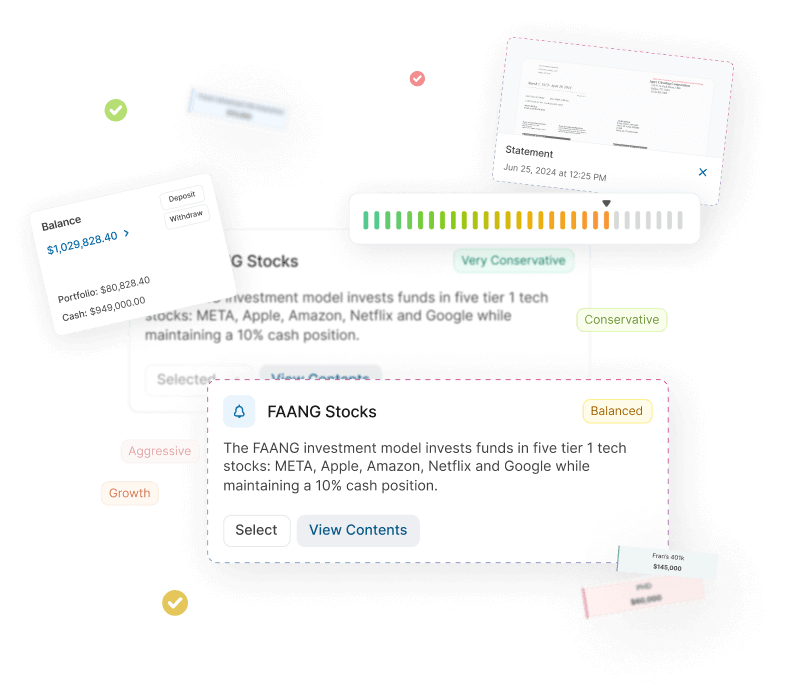
Demo Financial Advisor Software
Manage portfolios with advanced rebalancing and real-time insights.
Access customizable client reports and streamlined compliance tools.
Designed for advisors seeking efficient client and portfolio management.

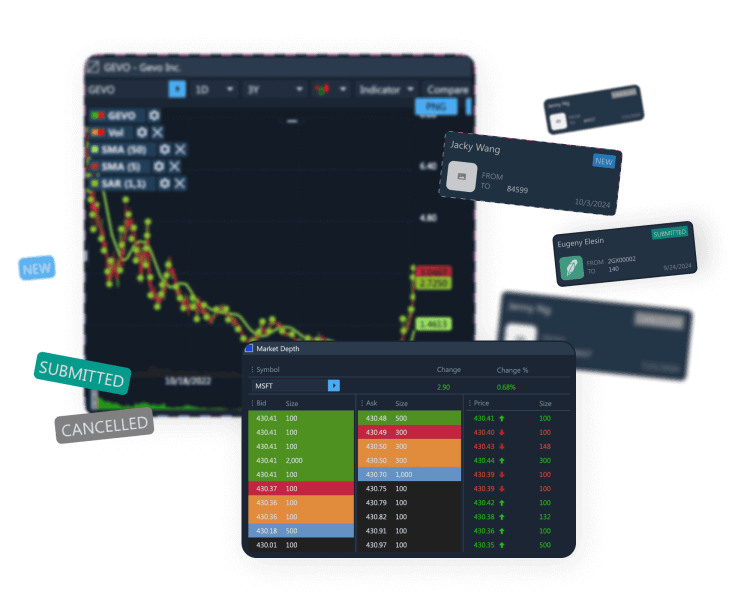
Demo Advanced Trading Platform
Test multi-asset strategies with real-time and historical data.
Analyze market depth, execute complex options, and algorithmic orders.
Ideal for refining strategies and risk management before live trading.

Demo Paper Trading Platform
Practice trading with virtual funds in real market conditions.
Simulate cash, margin, and day-trader accounts to gain experience.
Perfect for honing skills in a risk-free, customizable environment.